
Leinfelden-Echterdingen Cultural Association, Inc.
Altes Rathaus Musberg Gallery
Diethard Sohn: Quince Portraits
Opening Remarks, September 13, 2025
Dear Ladies and Gentlemen,
I am delighted to have the opportunity to introduce you to the artistic work of Diethard Sohn here at the Altes Rathaus Musberg Gallery and to discuss his quince portraits. Many of you are likely already familiar with the artist and his work and therefore know that these quince portraits represent only a part of his diverse body of work—that he is an artist who cannot be easily defined or pigeonholed.
This is beautifully illustrated by his artistic career and development, as he himself has reflected on and organized into a chronological overview. This overview is displayed as a poster in the entrance hall: images—round excerpts from larger works—appear like bubbles of passing time, popping up and bubbling upward.
As a 7-year-old, Diethard Sohn found his way into the world of art when a gallery moved into the immediate neighborhood of his parents’ home. In the late 1960s, it was above all the then-prevalent “universal language of abstraction” that dominated the paintings there and fascinated him. And yet it is figurative art that first engaged him as a teenager through drawing—and from which he has never quite broken away.
From the overview the artist provides, it is clear that as a young man he experimented with many styles, genres, and techniques, thoroughly exploring what painting is capable of and the possibilities it offers. In the paintings of the so-called Old Masters, it was the precision and richness of detail—as well as the directness of the depiction—that fascinated him and have held his attention ever since. At the same time, in the 1990s, he developed a style he calls “comic cubism,” which represents another facet of his artistic personality. Objects and figures appear simplified in a comic-like manner, often in surreal combinations. In addition to the dynamic graphic aspects, it is here as well the genuinely painterly challenges that interest the artist: the relationship between space and surface, and the interplay of colors that determine the mood and expression of the painting.
A constant theme running through his entire body of work is the portrait. Here, two aspects that fundamentally define Diethard Sohn’s artistic personality may converge: his empathy for his subject and his precision. Chance is not his thing. The ability to concentrate deeply and reflect is inherent in his portraits.
And that finally brings us to the quince: Perhaps some of you have already wondered why the exhibition is called “Quince Portraits.” After all, a painting of a quince would normally be described as a still life. Diethard Sohn treats the quince as a counterpart, as an individual with its own forms and its own expression. “Every quince has its own presence, its own expression,” says the artist, “one, for example, comes across as flirtatious, while another is more shy.” Diethard Sohn is able to engage with this, to sense his subject. The quinces he paints are not merely still lifes in the classical sense, but portraits. They are the result of intense observation, concentrated study of the subject, and painterly distillation—almost a form of contemplation. Every trace, every quirk is interpreted—just like a human face. And it is precisely the process of decay that yields structures of particular interest to the artist.
It is no coincidence that these portraits of quinces evoke the paintings of the Renaissance or the Baroque period. The precision and attention to detail characteristic of the Renaissance—and perhaps also the artists’ enthusiasm for the then-new possibilities of depicting objects so true to nature—are also evident in Sohn’s works. (A review of his artistic development also reveals a beautiful phase influenced by Dürer’s watercolors.) In fact, Diethard Sohn has also studied the painting techniques of that era in great depth—he has practically mastered them—so that he could likely work as a restorer without any difficulty if he chose to. The construction of the quince portraits is based on this old-master technique—beginning with the preparation of the painting surface using chalk and rabbit glue, through the application of an imprimitur after the primer, then the gray underpainting, and the subsequent layers of egg tempera (in a few paintings, acrylic), which bring the actual motif to life. And this is where it gets very interesting, because the artist does not slavishly adhere to the correct sequence of the process; instead, he experiments with these layers and leaves them visible in the finished painting. For example, what appears at first glance to be the wooden substrate showing through at some of the edges of the painting is actually the orange-brown imprimitur applied with a broad brush. This creates the illusion of wood in the painting and, as the painting process continues, also the illusion of a quince: a trompe l’oeil—“an eye-deceiver”—an illusionistic painting that pretends to be something other than paint. But Sohn goes even further, for what he can also make us believe is that the painting is not on a panel but on parchment—and is thus, after all, painting once again. Is this the illusion of an illusion?
If you look closely, you’ll notice that Diethard Sohn takes a very liberal approach to this principle of illusion. There are certain details in the works that are rendered with a particularly intense sense of illusion—others less so.
The artist does not slavishly follow the contours of the quince, nor does he imitate every detail. The painting has a life of its own; it is its own reality. This series is not about representation; it is about perception and painting itself. Sohn elegantly combines opposites: he juxtaposes material (i.e., paint) and illusion (which pretends not to be paint) in an iridescent manner. Thus, what is depicted here is not merely a quince, but painting itself. In some paintings, the gray underpainting remains the topmost layer of color, appearing as a grisaille—a style of painting that simultaneously pretends to be made of stone, that is, a work of sculpture. Here, too, the same applies: What you see is not a stone fruit—it is a painting, no matter what it purports to be.
Painting is not reproduction—it is creation. Paul Cézanne once said, “To paint from nature does not mean to copy the object; it means to give expression to one’s feelings.” Diethard Sohn, too, gives expression to his feelings—in a different form than Cézanne, of course, but there are certainly parallels in their approach. Just think of Cézanne’s famous quote: “With an apple, I want to astonish Paris.” Here we have not apples, but quinces, but it is clear that the specific type of fruit is not what matters in the first place. Incidentally, Sohn’s body of work also includes a painting of a pear from 2008. He began working with quinces in 2014. Even if the connection to Renaissance art is evident—in the symbolic context of that era, the pome fruit refers to Jesus as the new Adam, who brings redemption from original sin through his death—this plays no role for Sohn. Rather, one could draw on the symbolic framework of Baroque art, in which the still-life genre first emerged. In keeping with the Baroque, the central theme of still lifes is transience. The theme of transience is beautifully depicted both in Baroque art and in Diethard Sohn’s work in the form of a fly, but even more clearly, of course, in the process of decay itself.
“The process of decay creates a painterly atmosphere,” says the artist. He is fascinated by the incredible textures, traces, and clues—their aesthetics, form, and color. Mood and emotions are conveyed through color; vitality and transience exist side by side. Sohn’s portraits of quinces exude a meditative calm. Seeing—perceiving—feeling is the triad inscribed within them. The process of painting itself becomes the subject of the painting.
In the small front room, the artist has displayed the tools and materials he uses in his work, and perhaps visitors will even be able to observe him painting there at some point during the exhibition. Also on view in this room is a video installation by his partner, Irene Müller, with whom he maintains an artistic collaboration under the name Müller & Sohn. Landscape, nature, and change brought about by human intervention are her themes. In the work titled “Appearance. Tree in Front of the Studio, One Year: Sep 2024 – Sep 2025,” the growth and decay of the quinces over the course of a year are condensed into a 3-minute video. Thus, the quince takes on yet another meaning here.
I’d also like to mention the gray-shaded quince in the last room. It’s a tribute to Ben Willikens, who had the last exhibition here at the gallery before Diethard Sohn.
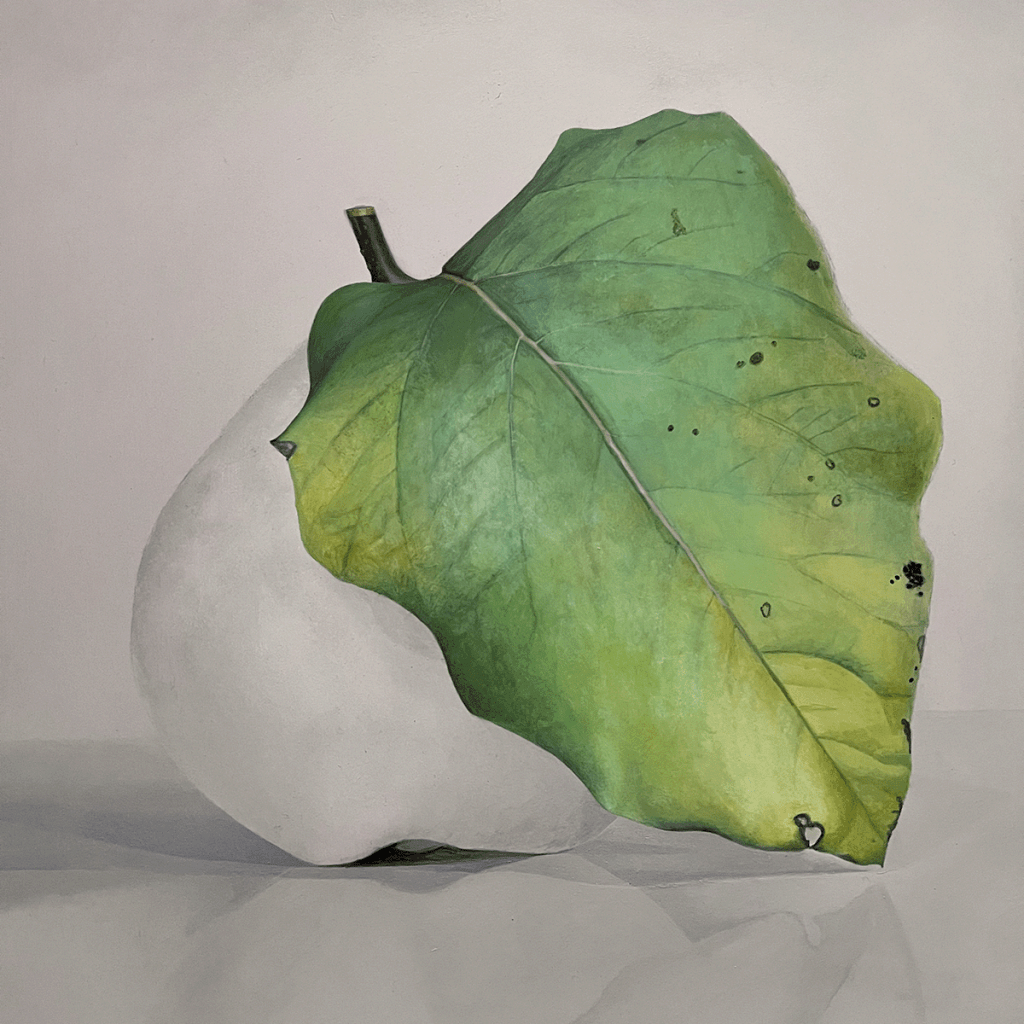
Homage to Ben Willikens
One can certainly draw a connection between these two very different painters, which may lie in the precision of their work. But I also see this homage as a tribute to the exhibition venue and the Leinfelden-Echterdingen cultural community, which guides the gallery’s direction. And indeed, I also believe that a great deal of thought has gone into everything here, and it is no coincidence that we are opening an exhibition of quince portraits here in late summer (or early fall?) on such a beautiful day. I can almost smell them.
Birgit Wiesenhütter
Birgit Wiesenhütter is a German art historian (M.A.) and independent curator. She works at the intersection of collections, exhibitions, and the public, primarily in the Stuttgart area and the Baden-Württemberg region.